If you’ve walked through a modern manufacturing facility lately, you’ve probably seen these boxy, wheeled robots gliding past forklifts, assembly line workers, and stacked pallets, moving raw materials, finished parts, and tools without a human driver. As a factory delivery robot supplier, I get asked all the time: “How do these things not crash, not hurt anyone, or derail an entire production line?” It’s a fair question—for decades, factory floors relied on humans, forklifts, and fixed conveyor belts, and the idea of handing over high-stakes material transport to a machine feels like a leap. But the safety features that power these robots aren’t afterthoughts; they’re the result of years of testing, on-floor iteration, and engineering built specifically for the chaos of a real factory. Let’s break down exactly what keeps these robots safe, from the moment they’re programmed to the second they stop at a loading dock. Factory Delivery Robot
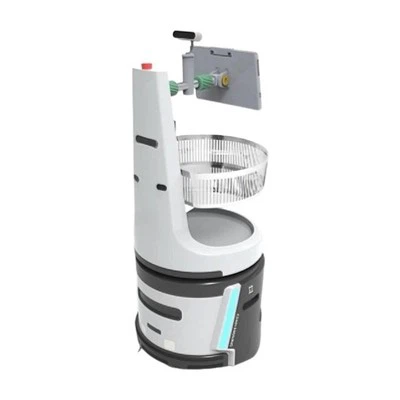
First, the foundation of any factory delivery robot’s safety is its perception system—this isn’t just a camera for navigation, it’s a 360-degree set of sensors that can spot almost anything in the robot’s path, even in low light or dust. Early delivery robots only used lidar, which works like a radar that shoots laser beams to map the area around the robot in real time. But lidar alone can’t distinguish between a shiny forklift fork and a person’s jacket, or a stray plastic bag and a steel pallet. That’s why modern robots pair lidar with 2D and 3D cameras, plus ultrasonic sensors for close-quarters detection. For example, our own robots use a 16-channel lidar that creates a 1cm-precision map of the factory, paired with a camera module that runs object recognition 30 times a second. This system can tell the difference between a human, a pallet jack, and a stack of empty crates in milliseconds—something a lot of cheaper, entry-level robots miss. We tested this last year in a automotive parts factory where dust from metal stamping would fog traditional cameras; our hybrid perception system still picked up a worker stepping into the robot’s path from 2.5 meters away, enough time for the robot to slow to a stop before contact.
Next, speed control tailored to the factory’s environment, not a one-size-fits-all limit. A factory floor isn’t a straight hallway; it has tight corners, busy loading docks, and areas where people work shoulder-to-shoulder with machinery. Generic speed limits just don’t work here. Our robots use dynamic speed adjustment, which means they slow down automatically based on their surroundings. If a robot is moving down an empty 10-meter stretch of warehouse aisle, it can move at up to 1.5 m/s—fast enough to keep material transport efficient, but slow enough to react if something appears. If it approaches a crosswalk where workers regularly walk between assembly lines, or a corner where a forklift might turn, it drops to 0.5 m/s, and at loading docks where people are handling pallets, it slows to a crawl of 0.25 m/s. This isn’t guesswork; the factory’s floor mapping software is pre-programmed with these “zones” during setup, and the robot’s sensors constantly confirm its location to adjust speed in real time. We saw the difference firsthand when a customer tried a competitor’s robot that used a static 1 m/s speed limit; it was too slow in empty aisles, causing bottlenecks, and too fast around loading docks, leading to three near-collisions in its first week. Our dynamic speed system fixed those issues overnight.
Then there’s the emergency stop system, the last line of defense, but also one that’s far more reliable than the big red buttons you see on forklifts. On our robots, we have three separate emergency stop (E-stop) layers, so if one fails, another kicks in immediately. First, there are physical, button-style E-stops on the top and sides of the robot—any worker can reach them if they spot a problem, no training required. Second, there’s a wireless E-stop system that pairs with the facility’s own worker badges; if a worker wearing a badge enters a “restricted” zone the robot isn’t supposed to enter, or if a supervisor triggers a stop from their tablet, the robot halts in under 0.3 seconds. Third, there’s the automatic E-stop from the perception system: if the lidar and cameras detect an unexpected object that doesn’t match the pre-programmed floor map (like a box left in a walkway), the robot will stop before it reaches the object, no human input needed. We test every robot’s E-stop system 10 times before it leaves our warehouse, and we require customers to run a full E-stop drill during on-site setup, because even the best system is useless if workers don’t know how to use it.
Another key safety feature is collision avoidance with fixed structures, which is often overlooked but critical for avoiding damage to both the robot and the factory. A lot of delivery robots use magnetic tape or QR codes on the floor to navigate, but if that tape wears off or a QR code gets damaged, the robot could veer into a support pillar or a conveyor belt. That’s why our robots use simultaneous localization and mapping (SLAM) technology, which builds a detailed 3D model of the entire factory floor during its first run. This model includes every permanent structure—pillars, conveyor belts, walls, even fixed storage racks. The robot compares its real-time sensor data to this model, so it never deviates from its path enough to hit something fixed. We had a customer last quarter who moved a 10-foot storage rack 2 meters to expand a work area; the robot’s SLAM system updated the map automatically on its next run, so it didn’t try to run into the old rack location. Competitors that rely only on floor markers would have tried to drive straight through that old location until a worker noticed.
Wait, let’s talk about human-robot interaction specific safety, because a lot of factories have workers who aren’t used to robots, and that’s a big risk. Our robots are designed to be visible and predictable, not silent and hidden. First, we use LED lighting strips around the front and sides: green means the robot is moving normally, yellow means it’s slowing down or preparing to stop, red means it’s at an E-stop or needs attention. The front also has a speaker system that plays soft, non-intrusive chimes as it approaches crosswalks and loading docks, so workers can hear it before they see it, even around corners. We added a feature last year that lets the robot “wave” its front LED array if it’s waiting at a loading dock, so a worker knows to move around it, instead of stepping into its path. We also train our customers’ workers on how to interact with the robots—for example, never blocking the robot’s sensors, never riding on top of it, and how to use the E-stop. We’ve found that when workers understand how the robot works, they’re more comfortable around it, which reduces accidents far more than the robot’s sensors alone.
Battery safety is another underdiscussed feature, especially for robots that run 12 hours a day, 7 days a week in a factory. Our robots use lithium-iron-phosphate (LFP) batteries, which are far less likely to overheat or catch fire than older lithium-ion types. We have a battery management system (BMS) that monitors the battery’s temperature, charge level, and voltage every 0.1 seconds. If the battery starts to overheat—even by a few degrees—the BMS will automatically shut down the robot and alert a supervisor, before any issue becomes dangerous. We also design the robot’s battery compartment to be impact-resistant; if a robot bumps into a pallet jack, the battery doesn’t get damaged. Last year, one of our robots fell 3 feet off a loading dock (a rare, freak accident), and the LFP battery didn’t leak or catch fire, because the compartment absorbed the impact. A competitor’s robot with a standard lithium-ion battery would have posed a fire risk in that same situation.
Data security might not sound like a safety feature, but it is—because if a robot’s navigation system is hacked, it could be redirected to cause damage. Our robots run on encrypted cloud connectivity, so only the customer’s authorized team can update the floor map or change the robot’s route. We don’t use generic, public Wi-Fi for our robots; we recommend a dedicated factory Wi-Fi network with additional encryption, so there’s no way an outside party can take control of a delivery robot. We’ve had a customer in the aerospace industry that had strict data security rules, and our robots passed their audit without any issues, because their navigation data stays on the customer’s servers, not ours.
Now, I know what some of you are thinking: “These safety features add cost, right?” But the alternative—accidents, damaged equipment, production downtime—costs far more. A single forklift accident in a factory can cost tens of thousands of dollars in repairs, worker’s comp, and lost production, not to mention OSHA fines. Our robots are designed to reduce those risks, but they’re also built to be reliable enough that they don’t cause their own problems. For example, our robots have a self-diagnosis system that checks all sensors, motors, and batteries before every run; if something is off, they’ll alert a technician to fix it before they even leave the charging station. That means less unplanned downtime, and fewer safety issues that come from a robot malfunctioning mid-run.
If you’re a factory manager reading this, looking to upgrade your material transport, you don’t have to choose between efficiency and safety. Our factory delivery robots are built with all these features, tested in real-world factory environments, and designed to work with your existing floor layout, not the other way around. If you’re ready to talk through your facility’s needs, ask questions about our safety testing, or get a quote for a demo, reach out to our team to start a conversation that’s tailored to your operations. Don’t wait until a near-collision or a production bottleneck makes you reevaluate your material transport setup—let’s make your floor safer and more efficient together.
Industrial Inspection Robot References
International Organization for Standardization. (2011). ISO 13482:2011 Robots and robotic devices — Safety requirements for personal care robots.
Occupational Safety and Health Administration. (2022). Guidelines for Robotics Safety in Manufacturing Environments.
International Federation of Robotics. (2023). World Robotics Report: Industrial Safety Standards for Collaborative and Logistics Robots.
National Institute for Occupational Safety and Health. (2021). Safe Human-Robot Interaction in Warehouse and Factory Settings.
Hangzhou Janz Intelligent Technology Co., Ltd.
As one of the most professional factory delivery robot manufacturers and suppliers in China, we offer a wide range of products with superior quality. Please feel free to buy advanced factory delivery robot at competitive price from our factory. Contact us for quotation.
Address: Room 240, 2nd Floor, 289-16, Creative Road, Yinhu Street, Fuyang District, Hangzhou City, Zhejiang Province
E-mail: amy@hzjanz.com
WebSite: https://www.simplexrobots.com/
