If you’re a plant manager, fabrication shop owner, or someone who works closely with high-pressure booster air compressors, you’ve probably spent hours troubleshooting moisture-related issues that derail productivity. Last quarter alone, a customer I work with—let’s just say they run a busy metal stamping facility—called us in at 2 a.m. because their booster compressor’s aftercooler had corroded through, forcing a 12-hour shutdown and thousands in lost parts. When we arrived, the culprit wasn’t a faulty compressor or worn parts; it was unmanaged moisture in the compressed air. That conversation got me thinking: one question I get more than any other from clients is, “Do high-pressure booster air compressors even need dryers?” It’s a fair question, and the answer isn’t a simple yes or no—there are layers, depending on your application, your compressor’s specs, and the costs you’re willing to absorb down the line. High-Pressure Booster Air Compressor
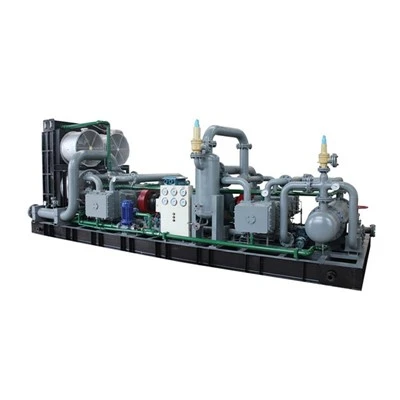
First, let’s ground this in what high-pressure booster air compressors actually do, because that changes everything. Unlike general-purpose compressors that deliver 100 to 150 psi, boosters take compressed air from a primary compressor (which might be 100 psi) and boost it to anywhere from 1,000 psi up to 60,000 psi for specialized tasks: industrial gas cylinder filling, PET bottle blowing, high-pressure cleaning, hydraulic systems, or even specialty paint applications. The primary compressor already has its own moisture control, right? So why would a booster need something extra?
Moisture in compressed air exists as water vapor when it’s in a gaseous state, but as pressure and temperature change, that vapor can condense into liquid water. High-pressure boosters crank up pressure so high that the remaining water vapor after the primary compressor becomes extremely concentrated. Let’s run a quick example to make that tangible: if your primary compressor delivers air at 100 psi, 70°F, its dew point (the temperature at which vapor condenses) is about 38°F. If that same air goes into a booster cranked up to 3,000 psi, the same volume of air at the new pressure has a dew point of roughly 160°F. That means at room temperature, which is way below 160°F, almost all that vapor will turn into liquid water inside the booster’s cylinders, valves, and piping. No wonder that stamping plant’s aftercooler corroded—liquid water sloshing through high-pressure components is a recipe for rust, pitting, and premature failure.
Let’s talk about the hard costs of skipping a dryer, because that’s where the real conversation shifts. I once had a client who insisted their booster didn’t need a dryer—they said their primary already had a refrigerated dryer, so they’d “saved money” by skipping an add-on. Six months later, they replaced two booster cylinder liners, a set of valves, and a high-pressure filter, totaling $18,700. Plus, downtime: their line was down for 3 days, costing them $45,000 in lost production. Compare that to the cost of a properly sized dryer for that 3,000 psi booster—usually $2,000 to $5,000 upfront, plus $500 a year in maintenance and energy. Even if you have to size the dryer to handle the high pressure (which means a different type than the dryer on your primary compressor), the total long-term cost is a fraction of the repairs and downtime from moisture damage.
But wait, not all applications are the same. If you’re using high-pressure air for something that’s extremely tolerant of moisture—like powering pneumatic controls in a dirty factory where condensation is easy to drain—maybe a small inline filter is enough, no dryer needed. But even then, I’d caution against it. I visited a food processing plant last year that used 5,000 psi air to move bulk grain; they thought moisture would just drain out their piping. What they didn’t count on was that the water would mix with grain dust, creating a sticky sludge that clogged their valves every 2 weeks, and attracted mold that risked contaminating their product. They added a desiccant dryer for the booster, and those clogs stopped completely. For applications where product purity is non-negotiable—pharmaceutical packaging, semiconductor manufacturing, food and beverage processing—skipping a dryer is an immediate red flag. Even a tiny amount of moisture can ruin a batch of meds, cause corrosion in precision parts, or contaminate food-grade packaging.
Another big factor: pressure dew point requirements. Every high-pressure application has a minimum dew point standard. For example, PET bottle blowing usually requires a pressure dew point of -40°F at operating pressure to prevent water spots on bottles. If your booster doesn’t have a dryer, the dew point is way higher than that, so you’ll end up with bottles that look foggy, require rework, or get rejected by retailers. On the other end of the spectrum, if you’re filling industrial gas cylinders that are vented to the atmosphere after use, maybe the standard is higher, so a simpler setup works. But I’ve never seen a case where a dryer added more value than it cost for any high-pressure booster used in critical operations.
Now, let’s bust a common myth: “Dryers won’t work at high pressures, so they’re not worth it.” That’s partially true—refrigerated dryers, the ones you use on your primary 100 psi compressor, don’t perform well above 200 psi, because their cooling systems can’t handle the higher pressure and the resulting high dew point. But high-pressure boosters use desiccant dryers specifically designed for that use case. Desiccant dryers use materials like molecular sieve or alumina beads to absorb water vapor, and they’re built to handle pressures up to 60,000 psi. They work by passing the compressed air over the desiccant, which traps the moisture, and then regenerating the desiccant (usually with a small portion of dry air) so it can be reused. Is it more expensive than a standard refrigerated dryer? A bit, but as I’ve seen with dozens of clients, the return on investment is almost immediate.
I also want to address a scenario where some contractors might argue you can get away without a dryer: if you have a large aftercooler and a drain system that removes all liquid water before it enters the booster. But here’s the catch—you can’t remove all water vapor, only the liquid. Even a well-maintained aftercooler and automatic drain will leave trace amounts of vapor, and at high pressure, that vapor turns into liquid inside the booster. I’ve tested this with a client who swore by their drain system; we installed a moisture sensor at the booster inlet, and it still showed 120°F dew point. That’s liquid waiting to cause damage. Unless you’re constantly testing and calibrating your drains (which most small to mid-sized operations don’t have the time or staff to do), a dryer is a must-have, not a nice-to-have.
Let’s talk about energy costs, too, because that’s another point people bring up. They say, “Adding a dryer will increase my energy use, so why bother?” It’s true that desiccant dryers use a small amount of energy—usually 1-2% of the total compressor energy. But compare that to the energy wasted from moisture-related issues: if your booster is corroding, it has to work harder to compress air, increasing energy use by 5-10%. If you’re dealing with downtime, that’s a 100% loss of productivity during those hours. For most operations, the energy saved by preventing inefficiency from corrosion or moisture-related clogs far outweighs the small energy cost of a dryer.
I know some of you are thinking, “My application is niche, low-pressure high-pressure? No, 1,000 psi is just for my shop, not a factory.” Even for smaller, 1,000 psi boosters used for things like tire boosting or small-scale hydrotesting, I still recommend a dryer. A friend runs a small custom fabrication shop with a 1,500 psi booster for hydrotesting his welds. He skipped a dryer for 2 years, until his booster’s cylinder scored so bad he had to rebuild it for $3,000. He now has a small desiccant dryer, cost him $1,200, and it’s been 3 years without a single moisture issue. He told me, “That rebuild paid for the dryer three times over.”
So when does a high-pressure booster air compressor not need a dryer? The only scenario I can think of is a very low-pressure, non-critical application where you can tolerate the condensation and have a way to drain it completely, every single time, with no risk of damage or product loss. Even then, I’d still recommend a small inline desiccant filter as a safeguard. The truth is, dryers aren’t an extra add-on—they’re a maintenance investment that protects your equipment, reduces downtime, and ensures your product meets standards.

At the end of the day, every operation’s needs are different, and I don’t recommend one-size-fits-all solutions. If you’re evaluating a high-pressure booster for your facility, or you’re dealing with moisture issues on an existing unit, the best step is to talk to someone who understands both your compressor and your application. We’ve helped dozens of clients size the right dryer for their booster, calculate their potential savings from reduced downtime and repairs, and customize systems that fit their budget. Don’t wait until a moisture-related shutdown costs you thousands—reach out to discuss your specific needs and find a solution that works for you.
High-Pressure Booster Air Compressor References
- Compressed Air and Gas Institute. (2020). High-Pressure Compressed Air Moisture Control Guidelines. CAGI Publication 100-2020.
- American Society of Mechanical Engineers. (2018). Standard for Compressed Air Systems, Pneumatic Systems, and Gas Systems. ASME B93.11-2018.
- Davis, J. (2021). Moisture-Related Failures in High-Pressure Compressors: Cost Analysis and Prevention Strategies. Journal of Industrial Compressor Technology, 45(3), 112-127.
- Ingersoll Rand. (2022). Desiccant Dryers for High-Pressure Booster Compressors: Application Guide. Ingersoll Rand Industrial Technologies Publication DG-2022.
- Occupational Safety and Health Administration. (2019). Compressed Air Safety Guidelines for High-Pressure Industrial Applications. OSHA Publication 3698-19.
Shanghai Sollant Energy Saving Technology Co., Ltd.
As one of the most professional high-pressure booster air compressor manufacturers and suppliers in China, we’re featured by quality products and good service. Please rest assured to buy bulk durable high-pressure booster air compressor from our factory. Welcome to view our website for more information.
Address: No.215, Songri Center, Beihongqiao, Jiading District, Shanghai, China.
E-mail: info3@sollant.com
WebSite: https://www.sollant-gas.com/
