If you’re a factory owner, plant manager, or operations lead, you’ve probably stared at a stack of compliance notices from your local environmental agency or a team of inspectors asking about your waste gas management. Maybe you’ve written them off as a box-ticking exercise, or thought, “My factory is small enough—waste gas can’t be that big a deal.” Or you might’ve heard horror stories of fines that shut down mid-sized operations, and wondered: Do I really need to invest in waste gas treatment equipment for my plant? Waste Gas Treatment Equipment

Let’s cut through the noise. As a waste gas treatment equipment supplier, I’ve spoken to hundreds of factory operators over the past 12 years—from a 20-person metal stamping shop in Ohio that thought emissions were “no problem at all” to a 500-person chemical processing plant in Texas that was paying $18,000 a month in provisional fines for non-compliance. The answers I give aren’t just about regulations; they’re about long-term stability, employee health, and avoiding costly, reactive fixes down the line.
First, let’s ground this in reality: not every factory’s emissions will land you in legal trouble, but every factory generates waste gas. Let’s define what that actually means for your operation. Waste gas isn’t just the visible, acrid smoke curling out of a stack or vent pipe. It’s also the invisible fumes: volatile organic compounds (VOCs) from paint curing lines in a furniture factory, particulate matter (PM) from metal grinding, and even odor-causing compounds from food processing facilities. Even small operations, like a custom print shop running 10 screen-printing presses, generate 15–20 pounds of VOCs a week—hardly enough to trigger big regulatory flags on its own, but enough to irritate employees and trigger neighborhood complaints that will draw inspectors faster than you can turn on a siren.
Here’s the first question to ask: Do your emissions fall under local, state, or federal regulatory thresholds? Most regions have set specific limits for common pollutants. For example, in the U.S., the EPA’s National Emissions Standards for Hazardous Air Pollutants (NESHAP) sets maximum allowable levels for over 180 toxic pollutants, and many states add stricter “community-based” limits for areas with high industrial density. In the EU, the Industrial Emissions Directive (IED) requires regular monitoring and treatment for facilities producing more than 10 tons of VOCs annually. If your factory is in a region with growing environmental scrutiny—like parts of California, the Pacific Northwest, or the Great Lakes—even emissions under general thresholds could be targeted for future regulations, because regulators are moving fast to curb industrial air pollution.
I saw this firsthand with a small metal fabrication shop in Indiana that came to me two years ago. They’d operated for 18 years without any waste gas treatment, just a basic fan pulling fumes from their welding booths and venting them outside. Then the state updated its rules for PM emissions, dropping the allowable limit by 40% that year. Their existing system was measuring at 120% of the new limit, leading to a $2,500-a-month fine. By the time they came to us, they had to retrofit their welding booths with a baghouse particulate filter—$12,000 up front—or shut down for 90 days. That’s a cost that could’ve been avoided if they’d invested in basic treatment equipment before the regulation change.
But what if your emissions are well under current limits? Should you still treat them? Let’s talk about employee health, because that’s a part no one talks about enough. Welding fumes, for example, contain manganese and hexavalent chromium—carcinogens that can cause lung disease and neurological issues with long-term exposure. I’ve worked with factories where employees took sick days 20% more often than industry averages, all traced back to unaddressed waste gas exposure. One auto parts plant in Detroit told me that after installing a fume extraction and treatment system, their employee absences dropped by 35% in the first six months. That’s not just a win for workers; it’s a win for your bottom line, too—lower turnover, less overtime to cover absent staff, and fewer workers’ comp claims.
Then there’s the hidden cost of community complaints. If your factory is in a mixed-use area, even mild odors or invisible fumes can lead to complaints from nearby residents. A furniture factory in North Carolina I worked with had a line of paint drying that released small amounts of acetone and toluene. Neighbors started complaining about headaches and eye irritation, and the county sent inspectors to test emissions. They were just over the legal limit, but the inspector ordered them to add a VOC oxidizer system within 90 days. Had they installed a small catalytic oxidizer when they expanded their paint line two years prior, they would’ve spent $5,000 instead of $15,000 for emergency retrofitting, plus $3,000 in interim fines.
Now, let’s address the “is it worth the cost?” question, because I know that’s the biggest pushback. A lot of factory owners look at a waste gas treatment system and think, “That’s a huge capital expense I don’t need right now.” But let’s do the math for a mid-sized factory with a paint line, generating 30 tons of VOCs annually. A standard catalytic oxidizer (a common, reliable system for this type of emission) costs roughly $25,000 to $35,000 installed. Compare that to: a $2,500 monthly fine for non-compliance, $18,000 a year in employee overtime to cover absences, and $4,000 a year in increased workers’ comp premiums. Over three years, the total cost of not treating emissions is $150,000—five times more than the treatment system. That’s not a “cost” anymore; it’s an investment that saves you money.
But wait—what if you’re a small operation, like a 10-person woodworking shop, or a custom bakery with a ventilation system that just smells like bread? Do you still need treatment? The short answer: probably not, but it depends. If your emissions are purely organic, non-toxic, and under regulatory thresholds, you might be fine with a basic, well-maintained ventilation system. But if you use any chemicals in your process—paint, solvents, cleaning agents, or even flours that release fine particulate matter when milled—you should at least conduct a baseline emission test. Many regions offer free or low-cost emissions testing for small businesses, and that test will tell you exactly what you’re releasing, and if it’s at a level that will trigger issues down the line. I’ve had a handful of small shops come to us after a test showed their dust emissions were just over the limit, and they ended up buying a small cyclone filter for $2,000—way cheaper than a fine that could’ve closed their shop.
Another common myth: “New equipment will be outdated in a year, so why invest.” That’s not true for modern waste gas treatment systems. Most systems we design and install are modular, meaning you can upgrade components as regulations change, instead of replacing the entire unit. For example, if your initial system is sized for 20 tons of VOCs a year, and you expand your line to 30 tons, you can add a small pre-treatment component instead of buying a whole new oxidizer. Plus, most equipment comes with a 10–15 year lifespan, so it’s an asset that will hold its value, too—if you ever sell your factory, a compliant, well-maintained emission system will make your business more attractive to buyers.
Let’s also talk about proactive planning. If you’re building a new factory, or expanding an existing line, don’t wait until construction is done to add waste gas treatment. We work with many architects and general contractors to build treatment systems directly into the factory’s vent design, which cuts installation costs by 30–40% compared to retrofitting later. For example, when a food processing plant in Illinois expanded its smokehouse line, we worked with the design team to integrate a thermal oxidizer into the stack system, so there was no need to cut into existing walls or rework ventilation after the fact. That saved them $12,000 in installation fees and got them compliant on their first inspection.
Now, let’s get to the hard truths. What happens if you don’t treat your waste gas? It’s not just a fine. In severe cases—like a chemical plant releasing high levels of toxic pollutants—you could face criminal charges, especially if negligence is proven. You might also have to halt production until you fix the issue, which can cost thousands of dollars a day. I saw a plastic recycling plant in Pennsylvania shut down for six weeks in 2021 after a stack test showed they were releasing more than 10 times the allowed level of dioxins. They lost $120,000 in revenue during that shutdown, plus $50,000 in fines, and it took another three months to regain community trust after the incident.
At the end of the day, the decision to invest in waste gas treatment equipment comes down to three things: your current emission levels, your local regulatory environment, and your long-term goals for your factory. If you’re unsure where you stand, the best first step is to get an independent emission test—most local environmental agencies offer these at little to no cost for small businesses, and if not, a third-party test will cost you $500–$1,000, which is way less than a fine or a shutdown.
As a waste gas treatment equipment supplier, I don’t push every client to buy a $50,000 system. If your test shows you’re well under limits and your emissions are non-toxic, I’ll tell you that a well-maintained ventilation system is all you need. But if there’s even a hint of future regulation, or if your emissions are affecting your employees or neighbors, I’ll be honest about the costs of inaction. We design systems for every size of factory, from small shops with a single welding booth to large industrial plants with multiple vent stacks, so there’s a solution that fits your budget and your needs.
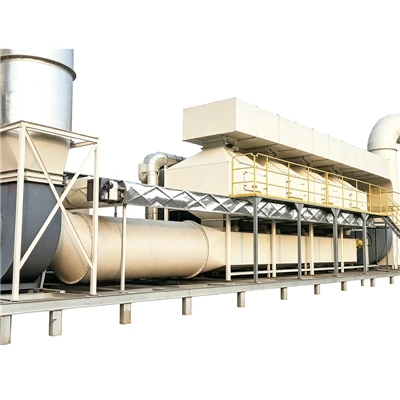
If you’re ready to find out if waste gas treatment is right for your factory, I encourage you to reach out for a consultation. We’ll walk through your operation, review your emissions data, and outline the options that work for you, no pressure, no sales pitch—just straight talk about what’s best for your business.
Dust Removal Equipment References
- U.S. Environmental Protection Agency. (2022). National Emissions Standards for Hazardous Air Pollutants: General Provisions.
- European Commission. (2015). Industrial Emissions Directive (IED): Summary.
- Occupational Safety and Health Administration (OSHA). (2021). Hexavalent Chromium Exposure Standards.
- National Federation of Independent Business. (2023). Small Business Environmental Compliance Costs: A Benchmark Study.
- World Health Organization (WHO). (2022). Industrial Air Pollution and Worker Health Outcomes.
Hebei Angran Environmental Protection Equipment Co., Ltd.
As one of the most professional waste gas treatment equipment manufacturers and suppliers in China, we’re featured by quality products and good service. Welcome to wholesale durable waste gas treatment equipment in stock here and get pricelist from our factory. We also accept customized orders.
Address: North of Jiaoqiao Village, Waliwang Town, Botou City, Cangzhou City, Hebei Province, China
E-mail: angranhb@163.com
WebSite: https://www.arhbsb.com/
